


The Room Has A Story

I recently added floating shelves to my room.
Three of them.
I do not know if “floating shelves” is the right term, but they are shelves, and they function without a whole architecture of wood. I saved a little more for my hobbies, had extra money specifically for myself, and decided that the wall needed more drama.
This, I think, is the danger of having a dark academia room. You add one small thing, and suddenly the room begins developing plot.
A minimalist aesthetic could never have done this for me. I respect minimalism in other people’s homes. I understand the appeal of clean lines, open space, and a room that says, “I am emotionally regulated.”
My creative soul would have perished. It would have stood in the middle of all that blank space, clutched its chest, and gasped, “Where are the books? Where are the dramatic curtains? Where are the chairs upholstered with vibes and audacity?”
Dark academia, on the other hand, understands that objects need lore.
It does not ask, “Is this useful?”
It asks, “Does this suggest a secret? Are the vibes correct? Is this spiritually part of the whole room?”
And apparently, several props in my cabinet have been waiting for their proper places in the light.
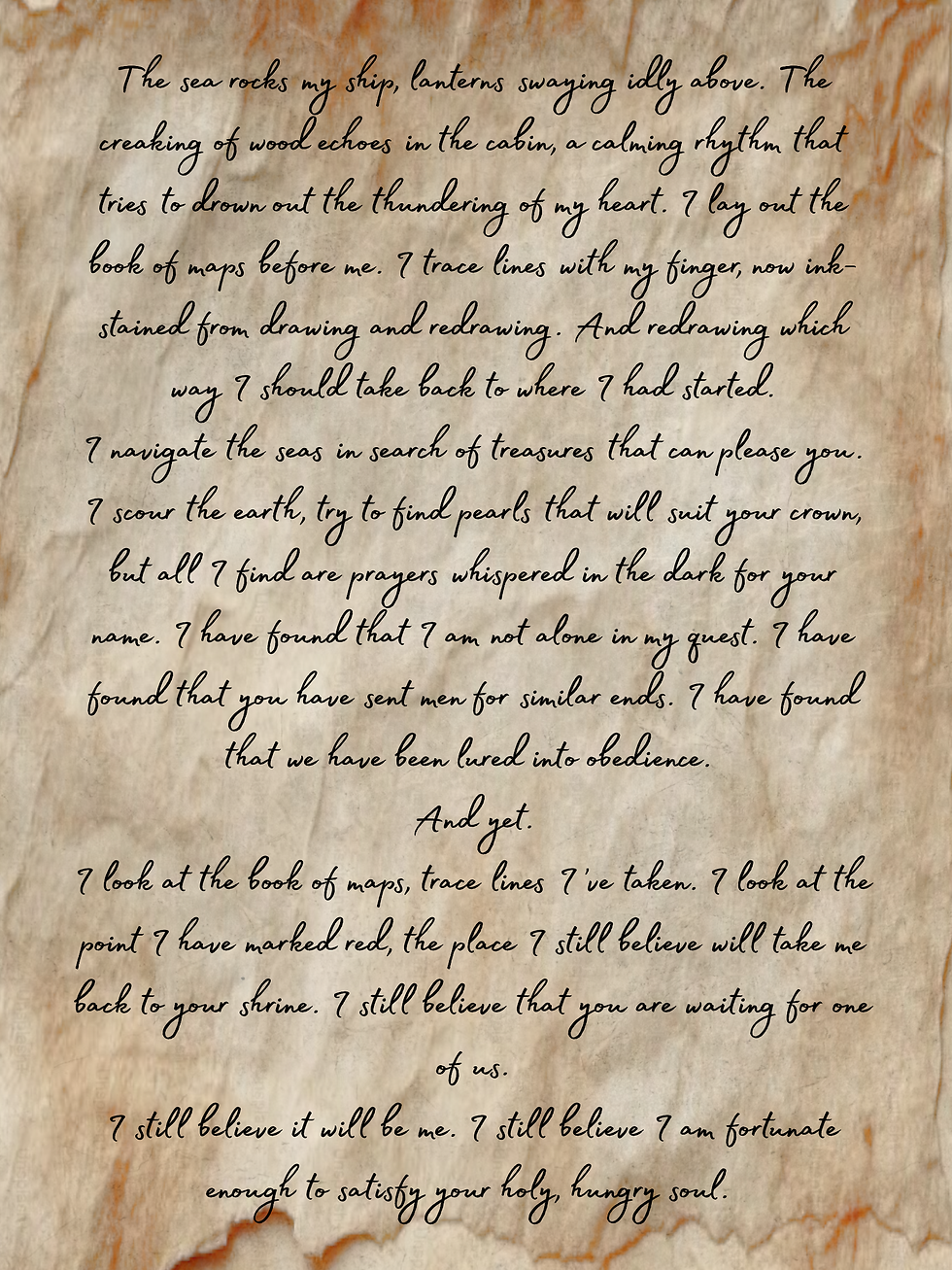
One of the shelves has become a maritime archive of sorts. It holds a framed piece of my own prose poem, printed over a parchment background. The text is about a ship, a book of maps, a hungry holy figure, and a narrator still believing they will be the one to satisfy devotion. You know. Casual wall décor.
Beside it, I placed a small ink bottle and a fountain pen. This was important because if I put a fake candle next to the framed text, the whole thing would have started looking like a shrine. A beautiful shrine, yes, but still a shrine. The ink bottle and pen make it look less like someone is being worshipped and more like someone had preserved their memories in the sea.
It looked like I wrote it on parchment by lanternlight while the sea threatened the ship. Never mind that I edited it digitally and printed it like a sensible modern person. We will protect the illusion.
Then I remembered I had a fake starfish from my book flat lay photography era.
Specifically, from The Siren’s Thesis era.

Of course, the starfish had to go there. It already had history. And I just knew it was not random clutter.

Then, I found the mini lantern, also from the same book photography era.
At that point, the shelf stopped being a shelf with decoration. It became something with a proper plot.
Framed writing of sea devotion. Ink and pen. Starfish. Lantern. The whole thing now suggests that someone wrote something troubling in a ship cabin, left the evidence under lamplight, and disappeared before the tide turned.
This, naturally, made me squeal like I’m sixteen again.
The second shelf has a different story.
This one holds a sealed letter, another old freebie from The Siren’s Thesis. It has a printed sticker wax seal, which is technically not a real wax seal, but spiritually? It absolutely is.
Beside it is a large Victorian-ish gothic key.

I don’t know where this key came from. But I did find it years ago in one of the boxes we unearthed during the lockdown era. I don’t know what it opens. I don’t know if a treasure chest exists. I only know that I once painted over it for book flat lay photography, and now it has been promoted to permanent room décor.
A key with no known lock is practically a plot device.
There is also a plastic hanging plant on that shelf, because every secret letter and suspicious key needs a little decorative overgrowth. It gives the impression that the evidence has been sitting there for years, quietly waiting for someone foolish or poetic enough to investigate.
So now the shelves have stories.
The third shelf does not have its own tale yet, but I trust it will develop one in time. Rooms, like novels, should be allowed to reveal themselves gradually.
This is also how I ended up unearthing a candelabra from a school play we had around fifteen years ago. (Dang it, I’m old.)
Anyway. It was spare. Forgotten. An object from another theatrical era. I saw it and immediately thought, “Oh, darling, you have a new home.”
That is not overconsumption. That is resurrection of past relics.
The room is becoming less like a decorated space and more like a small museum of my creative eras. The book flat lay era. The dark academia book era. The maritime gothic era. The school theatre acting era. The “apparently, I own a suspicious key” era. The “I should be writing letters to Aunt Pricilla at 11 PM” era.
Because really, the more things I add, the more the room demands proper activity.
It’s starting to feel like I should be sitting under warm lamplight, with the fake candles flickering safely nearby, writing:
Dearest Aunt Pricilla,
I write bearing news that the heat is still unbearable. I shall turn the air conditioner on by evening.
Tonight, we shall have fish, fresh from the sea, cooked according to your liking. I shall send for the e-bike as soon as you are ready.
This is the problem with a successfully decorated room. It changes your verbs.
You no longer “go to bed.” You retire.
You no longer “put things on a shelf.” You curate.
You no longer “avoid folding laundry.” You delay household management due to unresolved estate concerns.
And yes, most of the room cost money. The shelves were bought. The décor was built gradually. Dark academia, being a maximalist aesthetic, does enjoy objects, layers, shadows, books, and things that look like they were recovered from an old study after someone vanished under mysterious but beautifully lit circumstances.
But the more I build the room, the more I realize that not everything beautiful has to be bought new.
Sometimes, the room does not demand sacrifice involving shopping.
Sometimes, the objects are already there. They are just waiting for their proper home.
And maybe that is why the room makes me so giddy. Not because it looks expensive. Not because it looks like a perfect room on the internet. But because it looks like mine. It holds little histories I recognize. It has proof that I have made things, imagined things, staged things, written things, loved things, forgotten things, and found them again.
A minimalist room may have given me peace.
This room gives me proof.
Proof that creativity does not always disappear when a project ends. Sometimes, it becomes a lantern on a shelf. Sometimes, it becomes a sealed letter waiting beside a key.
Sometimes, these objects are only waiting for a place where they finally belong.


Comments